Net Metering in Tamil Nadu: Rules, Network Charges and Export Rates
Published · Reviewed by Karthikeyan E
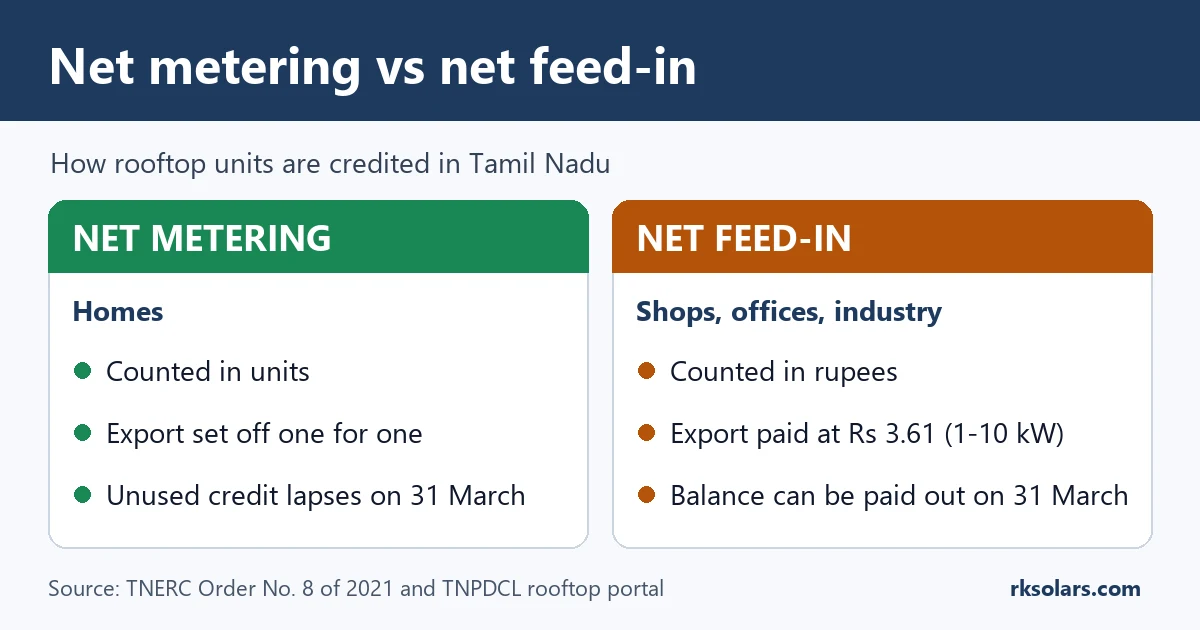
When your rooftop solar panels make more power than the house is using, the extra goes out to the grid. Net metering is the rule that decides what you get back for it. In Tamil Nadu that rule comes from one document, TNERC Order No. 8 of 2021. TNPDCL, which most of us still call TNEB, says on its rooftop portal that it follows this order today.
We read the order and the portal page line by line. Every number below comes from one of the two, and both are linked at the end so you can check them yourself.
The short answer for a home
| Question | Answer |
|---|---|
| Which method applies to a house? | Net metering. You may pick net feed-in instead. |
| How big can the system be? | Up to your sanctioned load. |
| What do I get for extra units? | They are set off against the units you draw, one for one. |
| What happens to unused credit? | It moves to the next bill. Anything left on 31 March lapses. |
| Is there a charge? | Yes. A network charge of 20% of Rs 1.53 a unit, for systems up to 10 kW. |
| Registration fee | Rs 500 for systems up to 20 kW. |
Three ways to connect, and who can use each
The order allows three methods for a rooftop solar system. Which one you get depends on the kind of connection you have, not on what you would like.
| Method | Who can use it | Size allowed |
|---|---|---|
| Net metering | Domestic consumers | Up to sanctioned load |
| Net feed-in, also called net billing | Every category except huts and agriculture | Up to sanctioned load, 999 kW at most |
| Gross metering | HT consumers other than domestic, and generators | 151 kW to 999 kW |
A shop, an office or a small workshop on an LT connection gets net feed-in. LT consumers cannot use gross metering at all.
How your bill is worked out
Net metering is counted in units
Say the meter shows 600 units drawn from the grid and 450 units sent out in a two-month cycle. You are billed for 150 units at the normal domestic rate. If you had sent out 700 units, the bill would show zero and the extra 100 would move to the next cycle. The rate for each slab is in our table of what a home pays per unit in 2026.
Net feed-in is counted in rupees
Units you draw are priced at your normal tariff. Units you send out are priced at the feed-in rate. The second amount is taken off the first. The feed-in rate is lower than what most consumers pay for grid power, so a unit you use yourself is worth more than a unit you export.
Network charges: the cost most quotes leave out
A network charge is what you pay for using the distribution lines. It applies to net metering and net feed-in. It does not apply to gross metering.
| Consumer | Charge per unit generated |
|---|---|
| Home, system up to 10 kW | 20% of Rs 1.53 |
| Home, system above 10 kW | 75% of Rs 1.48 |
| Other LT consumers | Rs 1.53 |
| Consumers above 150 kW on net feed-in | Re 0.96 |
The charge is on every unit the system generates, not only on the units exported. Small systems have no separate generation meter, so for anything up to 10 kW the order lets TNPDCL work the figure out from a 21% capacity factor, or from the inverter reading if that is lower. 21% comes to 5.04 units a day for each kilowatt.
A 3 kW home solar system over 60 days: 3 × 5.04 × 60 = 907 units. At 20% of Rs 1.53, which is about 31 paise, the charge is close to Rs 278 for the two months.
The 2021 order set the base figure at Rs 1.27. The portal now shows Rs 1.53. Ask for the figure in force on the day you apply.
Solar export rates (feed-in tariff)
| System size | Feed-in rate per unit |
|---|---|
| 1 to 10 kW | Rs 3.61 |
| 11 to 150 kW | Rs 3.37 |
| 151 to 999 kW | Rs 3.10 |
Power sent out between 6 pm and 9 pm earns 20% more. The rate stays fixed for 25 years for a system commissioned under the order.
For a home on net metering these rates never appear on the bill, because units are set off one for one. They matter if you choose net feed-in, or if the connection is for a business.
The 31 March rule
The settlement year ends on 31 March. Under net metering, any credit left on that day lapses and you are not paid for it. Under net feed-in you can take the balance as payment or carry it into the next year.
So a solar system that makes far more than the house uses gives units away every March. Size it to your own use. For most homes we visit in Coimbatore that means 2 kW to 4 kW. You can work out the size from your EB bill or see what a 3 kW system covers.
Limits that can stop an application
- Capacity is measured on the AC side and cannot go above your sanctioned load.
- All the rooftop solar systems on one distribution transformer together cannot pass 90% of its capacity. If the transformer on your street is near that, the application can be refused.
- Unpaid arrears on the service connection make you ineligible.
- If the system pushes out more than its sanctioned capacity, the extra is treated as inadvertent injection and is not paid for.
- The inverter must cut off by itself when grid supply fails. A lockable isolator for TNPDCL staff is also required.
- One bidirectional meter records both import and export.
Net meter application: fees and timeline
Registration costs Rs 500 for an LT system up to 20 kW. You apply on the TNPDCL rooftop solar portal, the same one used for a TNEB net meter. The order sets these outer limits, in working days.
| Step | Who does it | Working days |
|---|---|---|
| Acknowledge the application | TNPDCL | 2 |
| Site check, feasibility and letter of approval | TNPDCL | 15 |
| In-principle approval for central subsidy | TNPDCL | 10 |
| Metering agreement | TNPDCL and consumer | 15 to 20 |
| Installation | Vendor and consumer | 90 to 180 |
| Inspection, meter fixing and commissioning | TNPDCL | 15 to 20 |
| Inspection for release of subsidy | TNPDCL | 7 to 10 |
| Release of subsidy | TNPDCL | 5 to 10 |
These are the longest each step may take, not the usual time. For the subsidy side of the same process, read our step-by-step application guide and the amounts you can claim.
Questions people ask
Do I get paid for extra units under net metering?
No. Extra units are set off against what you draw from the grid. Whatever is still unused on 31 March lapses. Payment is possible only under net feed-in.
Can a home choose net feed-in instead?
Yes. The order gives domestic consumers that choice. Most homes do better with net metering, because a unit set off saves the full domestic rate, while an exported unit earns Rs 3.61.
I was put on net feed-in under the 2019 order. Can I move to net metering?
Yes. The 2021 order lets domestic consumers who were given net feed-in under Order No. 3 of 2019 move to net metering.
Do I pay network charges if I took the PM Surya Ghar subsidy?
Yes. The charge depends on the metering method and the size of the system. Taking a subsidy does not change it.
Can I add a battery?
Yes. The order says battery or generator backup must stay inside your own wiring. It must not feed the TNPDCL line when grid supply fails.
Sources and disclaimer
- TNERC Generic Tariff Order No. 8 of 2021, dated 22 October 2021
- TANGEDCO salient features and guidelines for the order
- TNPDCL rooftop portal: policies adopted
- TNPDCL unified rooftop portal
TNERC published a draft amendment to these regulations in June 2024. This page follows the rules the TNPDCL portal says it applies, checked on 30 September 2026. RK Solar Solutions is an installer and not a government agency. TNERC can revise these rates, so confirm the current figure with your section office before you sign.
Want your roof and sanctioned load checked against these limits? Book a free site visit.
Quick Links
Get In Touch
R k solar solutions 15-1, venkatachalapathy nagar, Koraithottam, Avarampalayam, Coimbatore -641006 GST NO : 33AWRPK5780A1ZH
rksolarsolutions@gmail.com
+91 98651 94406
Newsletter
© CTSV Solutions Private Limited. All Rights Reserved.