TNEB Tariff 2026: What a Home Pays Per Unit in Each Slab
Published · Reviewed by Karthikeyan E
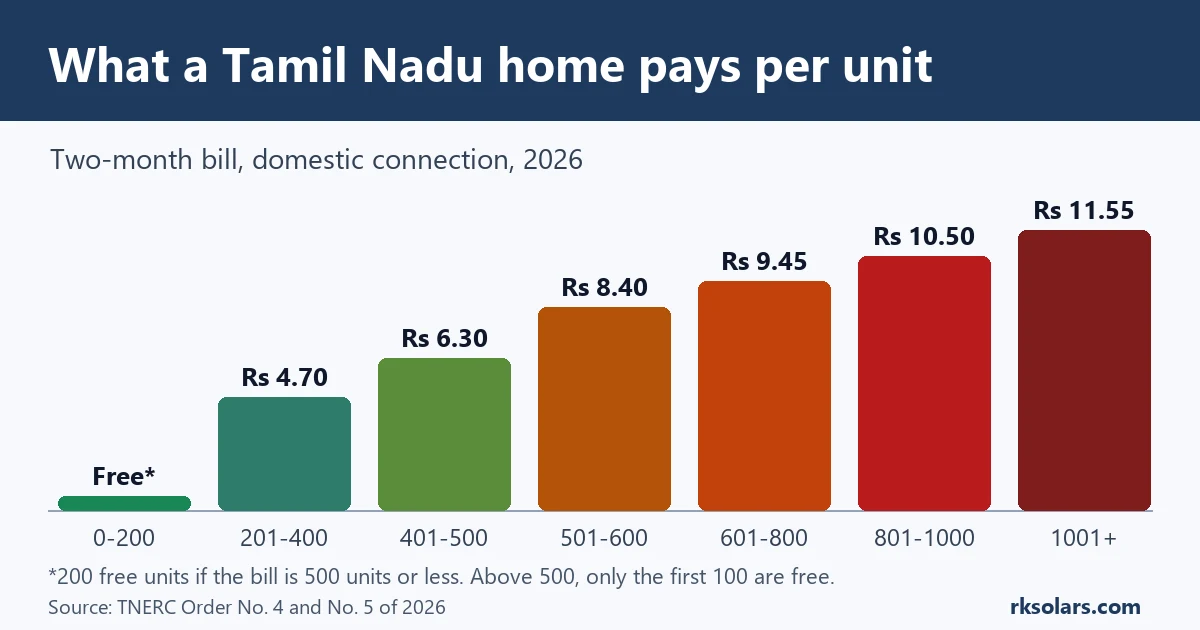
The rate printed in the tariff order is not the rate on your EB bill. TNERC, the state regulator, approves one figure. The Tamil Nadu government then pays a part of it for every home. What is left is what you pay.
Most pages on TNEB tariff mix the two figures up. We read the three orders in force and kept them apart. Each one is linked at the end, with the page number, so you can check any figure here against the source.
The short answer
| Question | Answer |
|---|---|
| How often is a home billed? | Once in two months. |
| How many units are free? | 200, if the two-month bill is 500 units or less. 100, if it is above 500. |
| What is the lowest paid rate? | Rs 4.70 a unit. |
| What is the highest? | Rs 11.55 a unit, above 1,000 units. |
| Is there a fixed charge? | No. It is nil for homes. |
| Since when? | Rates from 1 July 2025. The 200 free units from 10 May 2026. |
What you pay per unit
First find your total units for the two months. That total decides which of the two tables below is yours.
Bills of 500 units or less
| Units in two months | Approved rate | Government pays | You pay |
|---|---|---|---|
| 0 to 200 | Rs 4.95 | Rs 4.95 | Free |
| 201 to 400 | Rs 4.95 | Re 0.25 | Rs 4.70 |
| 401 to 500 | Rs 6.65 | Re 0.35 | Rs 6.30 |
Bills above 500 units
| Units in two months | Approved rate | Government pays | You pay |
|---|---|---|---|
| 0 to 100 | Rs 4.95 | Rs 4.95 | Free |
| 101 to 400 | Rs 4.95 | Re 0.25 | Rs 4.70 |
| 401 to 500 | Rs 6.65 | Re 0.35 | Rs 6.30 |
| 501 to 600 | Rs 8.80 | Re 0.40 | Rs 8.40 |
| 601 to 800 | Rs 9.95 | Re 0.50 | Rs 9.45 |
| 801 to 1,000 | Rs 11.05 | Re 0.55 | Rs 10.50 |
| Above 1,000 | Rs 12.15 | Re 0.60 | Rs 11.55 |
Each rate applies only to the units inside its own slab. A home that used 640 units does not pay Rs 9.45 on all 640. It pays that on the last 40.
Bill amounts from 100 to 1,200 units
These are energy charges for two months, worked out from the tables above.
| Units used | Energy charge | Average per unit |
|---|---|---|
| 100 | Rs 0 | Free |
| 200 | Rs 0 | Free |
| 300 | Rs 470 | Rs 1.57 |
| 400 | Rs 940 | Rs 2.35 |
| 500 | Rs 1,570 | Rs 3.14 |
| 501 | Rs 2,048 | Rs 4.09 |
| 600 | Rs 2,880 | Rs 4.80 |
| 700 | Rs 3,825 | Rs 5.46 |
| 800 | Rs 4,770 | Rs 5.96 |
| 1,000 | Rs 6,870 | Rs 6.87 |
| 1,200 | Rs 9,180 | Rs 7.65 |
The order says electricity tax, where the government levies it, is added on top of these rates. Your bill may also carry arrears or a deposit. Those are not part of the tariff.
The 500-unit line
Look at the two rows in the middle of that table. At 500 units the charge is Rs 1,570. At 501 it is Rs 2,048. One extra unit costs Rs 478.
The reason is the free units. Cross 500 and they drop from 200 to 100. So 100 units that were free are now charged at Rs 4.70, which is Rs 470. The 501st unit adds Rs 8.40.
If your home usually lands between 480 and 520 units, note the meter reading a week before the billing date. Putting off a few loads of washing or some hours of AC can keep you under the line.
How to calculate your own EB bill
- Take the present reading and subtract the previous one. Both are printed on the bill. That is your units for two months.
- If the figure is 500 or less, use the first table. If it is more, use the second.
- Multiply the units in each slab by the rate for that slab.
- Add the amounts.
Example, 640 units: the first 100 are free. The next 300 at Rs 4.70 come to Rs 1,410. The next 100 at Rs 6.30 come to Rs 630. The next 100 at Rs 8.40 come to Rs 840. The last 40 at Rs 9.45 come to Rs 378. Total, Rs 3,258.
What changed, and when
| Date | What happened |
|---|---|
| 9 September 2022 | TNERC Order No. 7 of 2022 set a five-year plan. Rates are revised every 1 July in line with consumer prices, by 6% at most. |
| 1 July 2025 | Order No. 6 of 2025 raised approved domestic rates to between Rs 4.95 and Rs 12.15. The government chose to pay the increase for homes, so bills did not change. |
| 10 May 2026 | G.O. (Ms) No. 50 raised free units from 100 to 200 for homes that use up to 500 units in two months. |
| 26 May 2026 | TNERC Order No. 5 of 2026 approved Rs 1,545.14 crore as subsidy to cover the extra free units until 31 March 2027. |
| 1 July 2026 | The next yearly revision was due. No order for it was on the TNERC list when we checked on 30 September 2026. |
Under the old rule a home paid Rs 2.35 a unit for units 101 to 200. That slab is now free for bills up to 500 units. A 220-unit bill that used to be Rs 329 is now Rs 94.
Shops, offices and small industries
These are the approved rates in Order No. 6 of 2025. Businesses also pay a fixed charge on the sanctioned load, which homes do not.
| Connection | Energy charge per unit | Fixed charge |
|---|---|---|
| Shops, offices, clinics and other general use (LT V) | Rs 6.65 if the two-month use is 100 units or less. Rs 10.45 on every unit if it is more. | Rs 110 per kW a month, up to 50 kW |
| Small industries and IT services (LT III-B) | Rs 8.25 | Rs 84 per kW a month, up to 50 kW |
| Cottage and micro units up to 12 kW (LT III-A 1) | Rs 4.95 up to 500 units in two months. Rs 7.15 above that. | Rs 77 per kW a month |
| Lift, pump and common lighting in apartments (LT I-D) | Rs 8.80 | Rs 110 per kW a month |
| HT industries (HT I) | Rs 7.50 | Rs 608 per kVA a month |
| HT commercial (HT III) | Rs 9.40 | Rs 608 per kVA a month |
HT consumers pay 25% more on units used from 6 am to 10 am and from 6 pm to 10 pm. Units used between 10 pm and 5 am get 5% off.
From 1 July 2025 the government held some of these at the older, lower rates for one year. That covered shops up to 500 units, industries up to 50 kW, and cottage units. The year ended on 30 June 2026 and we found no order extending it. Check the rate on your latest bill.
Where rooftop solar fits
We install rooftop systems, so you would expect us to say every home needs one. The slab table says otherwise.
If your home uses under 200 units in two months, your energy charge is already zero. Panels cannot bring it lower. Between 200 and 500 units you pay Rs 4.70 to Rs 6.30 a unit, and the payback is slow. Above 500 units the sums change, because each unit your roof makes replaces a unit from the costliest slab on your bill.
Example: a home that uses 800 units pays Rs 4,770. A 2 kW system in Coimbatore gives about 5.5 units a day for each kilowatt, or close to 660 units in 60 days. Under net metering the bill is raised on what is left, about 140 units. On the table above, that falls inside the free 200. A network charge of about Rs 185 for the two months still applies.
A shop on LT V pays Rs 10.45 for a unit from the grid and earns Rs 3.61 for a unit it exports. So a business system should be sized to what the shop uses in the daytime. The rules for both cases are in our guide to how exported units are credited in Tamil Nadu.
To see what size suits your bill, enter your units in the calculator. The central and state subsidy amounts are on a separate page.
Questions people ask
Are TNEB, TANGEDCO and TNPDCL the same thing?
For your bill, yes. TNEB is the old board's name. TANGEDCO ran distribution after that. The 2025 tariff order is issued to TNPDCL, the company that supplies and bills power now. The rates do not change with the name.
I used 520 units. Do I still get 200 free units?
No. The 200 free units are for bills of 500 units or less in two months. Above 500, the first 100 units are free and the rest are charged slab by slab.
Is there a fixed charge for a house?
No. The tariff order shows the fixed charge for the domestic category as nil. You pay only for the units.
Is the bill monthly or once in two months?
Homes are billed once in two months. The order prints every slab both ways, so 0 to 200 units a month is the same slab as 0 to 400 units in two months.
Can one house have two domestic connections?
The order allows one domestic connection for each dwelling unit. A separate floor with its own kitchen and its own wiring counts as a dwelling unit. Extra connections in the same unit are moved to a costlier tariff.
Will the rates go up in 2026-27?
A yearly revision linked to consumer prices, capped at 6%, was due from 1 July 2026. When we checked the TNERC tariff orders page on 30 September 2026, no order for it was listed.
Sources and disclaimer
- TNERC Order No. 6 of 2025, dated 30 June 2025. Domestic rates are on page 34, LT V on page 48.
- TNERC Order No. 4 of 2026, dated 27 April 2026. The rate payable by the consumer is on pages 7 to 9.
- TNERC Order No. 5 of 2026, dated 26 May 2026. This covers the 200 free units.
- TNERC list of tariff orders
Figures were checked against these orders on 30 September 2026. RK Solar Solutions is an installer and not a government agency. TNERC and the state government can change rates and subsidy at any time. For a disputed bill, go by the rate printed on the bill and ask your section office.
Is your bill above 500 units most cycles? Send us your last two bills and we will tell you, in writing, what a rooftop system would and would not save.
Quick Links
Get In Touch
R k solar solutions 15-1, venkatachalapathy nagar, Koraithottam, Avarampalayam, Coimbatore -641006 GST NO : 33AWRPK5780A1ZH
rksolarsolutions@gmail.com
+91 98651 94406
Newsletter
© CTSV Solutions Private Limited. All Rights Reserved.