Tamil Nadu BESS Policy 2026 Explained: Targets, the 10% Rule and Rooftop Impact
Published · Reviewed by Karthikeyan E
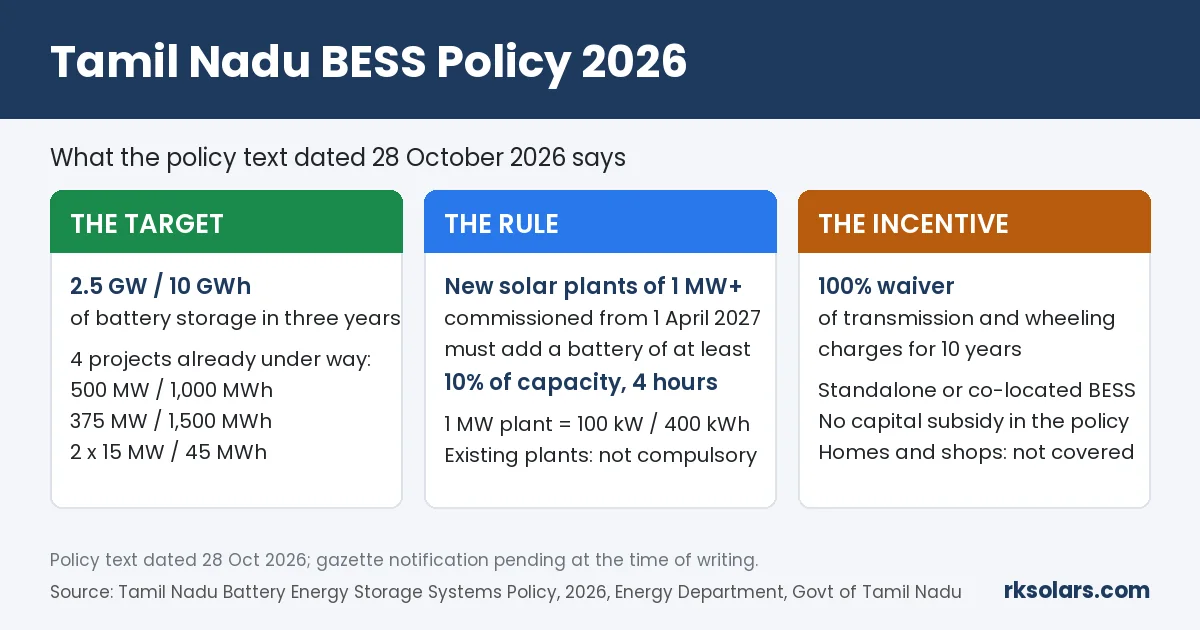
Tamil Nadu has written its first policy for large batteries on the grid. The Tamil Nadu Battery Energy Storage Systems Policy, 2026 sets a target of 2.5 GW / 10 GWh of storage, makes a battery compulsory for new solar plants of 1 MW and above, and gives a ten-year waiver on transmission and wheeling charges. Most news reports stopped there. This page goes through the full text, section by section, and then answers the question our customers actually ask: does any of this change a rooftop solar system on a house or a shop?
Short version: no. The policy is for plants of 1 MW and above. There is no battery subsidy in it. The parts that matter to a home come from a different document, the TNERC draft battery regulations, and we cover those too.
The short answer
| Question | Answer |
|---|---|
| Does it change my rooftop solar system? | No. The policy covers plants of 1 MW and above (sections 5 and 13). |
| Is there a battery subsidy? | No. The only incentive is a waiver of transmission and wheeling charges for large projects (section 14). TNGECL has said it is exploring a battery subsidy for the next phase of PM Surya Ghar, expected from April 2027 (reported by The New Indian Express, 23 October 2026). Nothing is approved yet. |
| Who is bound by it? | New solar and solar-hybrid plants of 1 MW and above that apply after notification or are commissioned on or after 1 April 2027 (section 13.3). |
| What does the state get? | At least 2.5 GW / 10 GWh of storage, with four projects already under way (section 1). |
| Is it in force? | Not yet. The document is dated 28 October 2026. It starts on the day of gazette notification (section 3). We will update this line when that happens. |
What the policy is, and where it stands today
The policy is issued by the Energy Department, Government of Tamil Nadu, through TNGECL, the Tamil Nadu Green Energy Corporation. The document we have is signed by the Managing Director of TNGECL on 28 October 2026. It was listed for the Cabinet meeting of 29 October (The New Indian Express, 28 October 2026). It has no G.O. number yet, and section 3 says it comes into force from the date of publication in the Tamil Nadu Government Gazette.
So, as of 30 October 2026, this is the version dated 28 October that we have; the gazetted text may differ. The dates inside it do not move with the gazette: the battery rule applies to plants commissioned on or after 1 April 2027 whatever the notification date. We will add the G.O. number and the gazette date here when they are published.
Download the documents
- Download PDF, 0.6 MBTamil Nadu Battery Energy Storage Systems Policy, 2026, dated 28 October 2026, 22 pages. Document as received from TNGECL. The gazette version will replace it here when issued.
- Download PDF, 0.2 MBTNERC order in M.P. No. 36 of 2025, dated 28 August 2025: substation land for the 1,000 MWh state-VGF battery project. Source: tnerc.tn.gov.in (the site may show a certificate warning)
- Download PDF, 0.6 MBTNERC order in M.P. No. 21 of 2026, dated 22 October 2026: 600 MW solar with 300 MW / 1,800 MWh storage from SECI. Source: tnerc.tn.gov.in
The targets and the four projects already under way
Tamil Nadu has about 29.8 GW of renewable capacity: 14.5 GW of solar and 11.6 GW of wind (section 1). Solar comes in the middle of the day and wind comes in gusts. Batteries store that power and give it back in the evening peak. The policy sets a floor of 2.5 GW / 10 GWh of storage during its three-year life.
Four projects are already being built (section 1):
- 500 MW / 1,000 MWh under the central Viability Gap Funding scheme, at six TANTRANSCO substations: Thennampatty, Anuppankulam, Ottapidaram and Vellalaviduthi (100 MW / 200 MWh each) and Kayathar and Karaikudi (50 MW / 100 MWh each). TNERC has allowed TANTRANSCO to lease the substation land to the developers at Re 1 a year for 15 years (M.P. No. 36 of 2025).
- 375 MW / 1,500 MWh under the VGF scheme funded through the Power System Development Fund, at eleven substations, including Palladam, Karamadai, Anaikadavu and Othakalmandapam in Coimbatore district.
- Two solar-with-storage plants of 15 MW / 45 MWh each, at Karur and Thiruvarur.
The Energy Department policy note for 2026-27 gives the dates: the 500 MW / 1,000 MWh project by December 2026, the 375 MW / 1,500 MWh project by September 2027, and the two solar-plus-storage plants by May 2027. Under the state component of the central VGF scheme, the centre pays up to 30% of the capital cost or Rs 27 lakh per MWh, whichever is lower (M.P. No. 36 of 2025, para 1.8).
Who the policy applies to: 1 MW and above
The policy recognises two kinds of battery project (section 5):
| Type | What it means |
|---|---|
| Standalone BESS | An independent battery of more than 1 MW (AC) connected to the transmission, distribution or a private consumer network. It is treated as a power asset on par with a generating company, as per Ministry of Power guidelines. |
| Co-located BESS | A battery built with a solar, solar-hybrid or other renewable plant of more than 1 MW, charged from that plant and discharged in peak hours. |
Anyone may build and run a battery project, whether an individual, a company, a partnership or any other legal entity, for sale to TNPDCL, for grid services or for any other purpose the law allows (section 4.3). The policy applies to projects that apply on or after the notification date, or that are commissioned on or after 1 April 2027 (section 4.2).
The New Indian Express reported on 28 October 2026 that industry had asked for plants up to 5 MW to be left out. That exemption is not in the text. One more point on the threshold: section 5 describes the two configurations as "more than 1 MW", while sections 13 and 14 say "1 MW and above"; a 1 MW plant should assume it is covered.
The 10% battery rule for new solar plants
This is the part that changes the economics of large solar in Tamil Nadu. From section 13:
- New solar and solar-hybrid plants of 1 MW and above, applied for after notification or commissioned on or after 1 April 2027, must install a battery of at least 10% of the plant’s installed capacity, able to discharge for four hours (section 13.3).
- Both the power (MW) and the energy (MWh) are measured on the AC side. The policy’s own example: a 100 MW (AC) plant needs 10 MW / 40 MWh (section 13.6).
- If the battery needs replacing during the project life, the developer pays (section 13.3).
- The battery’s power may not be more than the sanctioned capacity of the plant, and the discharge must go through the same connection point (section 13.8).
- Applications that do not meet these rules will not be considered by the nodal agency (section 13.9).
| Solar plant (AC) | Minimum battery |
|---|---|
| 1 MW | 100 kW / 400 kWh |
| 5 MW | 500 kW / 2 MWh |
| 10 MW | 1 MW / 4 MWh |
| 100 MW | 10 MW / 40 MWh |
Existing solar and wind plants of 1 MW and above are only “encouraged” to add storage (section 13.1). If they do, and the battery fits inside the sanctioned capacity, no separate load flow study is needed (section 13.2).
Substations get their own rule. New renewable pooling substations must have a standalone battery of 10% of their sanctioned capacity with four hours of discharge (section 13.4). Existing pooling substations must reach 5% by 2027-28 and 10% by 2028-29 (section 13.5). The text does not say who installs these; our reading is that TNPDCL or TANTRANSCO will, as standalone batteries near the substations (section 13.7).
Incentives: a ten-year charge waiver, nothing else
Section 14 gives one incentive. Eligible projects get a 100% waiver of transmission and wheeling charges for ten years from commissioning, subject to TNERC approval. Two kinds of project qualify:
- A co-located battery, in a new or existing solar, wind or hybrid plant, charged only from that plant and fitting within its sanctioned transmission capacity (section 14.3a).
- A standalone battery of 1 MW and above (section 14.3b).
Three conditions sit on top. The battery must be commissioned during the policy period. The waiver applies only to energy discharged outside solar hours and used inside Tamil Nadu (section 14.1). And the total capacity that can claim it is capped at 10 GWh (section 14.2).
What is not there matters as much. There is no capital subsidy, no SGST refund, no electricity duty or stamp duty concession, and no land allotment scheme. Fees and charges are left to the regulations, orders and bid documents of the competent authorities (section 18). The money for the four projects already under way comes from the central VGF scheme, not from this policy.
How TNPDCL will buy 2,500 MW / 10,000 MWh
TNPDCL, the distribution company most of us still call TNEB, will procure 2,500 MW / 10,000 MWh of storage in the first phase (section 12). The price will be found through competitive bidding and approved by TNERC. TNPDCL supplies the charging power for the batteries it procures, preferably in the solar hours of 10 AM to 2 PM (section 11.1).
Two kinds of price already exist, and they show what storage costs the state:
- A standalone battery is paid per MW per month. For the 375 MW / 1,500 MWh four-hour project, TNERC adopted tariffs of about Rs 3.15 lakh per MW per month for three developers, under 15-year build-own-operate contracts with central viability gap funding (M.P. No. 7 of 2026, 26 February 2026).
- Solar with storage is paid per unit. On 22 October 2026 TNERC approved TNPDCL buying 600 MW of solar with 300 MW / 1,800 MWh of storage from SECI for 25 years at Rs 3.12 a unit, plus a trading margin of Rs 0.07, with 300 MW available for any six hours TNPDCL picks between 6 PM and 9 AM (M.P. No. 21 of 2026). Supply is due 24 months after the PPA is signed.
The same order prints TNPDCL’s peak-hour deficit plan: a peak-hour shortage of 9,735 MW in 2026-27, rising to 16,332 MW by 2034-35 before new tie-ups; the order says the gap remains even after them, at 14,457 MW in 2034-35 (para 1.16). The 500 MW and 375 MW battery tenders are counted in that plan from 2027-28 and 2028-29. That is the reason behind the 2.5 GW target.
Operating rules a developer signs up to
| Rule | What the policy says | Section |
|---|---|---|
| Charging window | SLDC may direct charging during surplus solar hours, 10 AM to 2 PM; other times only as directed. | 10.6, 11.1 |
| Discharge point | At the same interconnection point as the plant or the standalone battery. | 11.3 |
| Availability | At least 95% in a year; mandatory availability from 1 March to 30 June and from 1 September to 31 October. | 15.10 |
| Control systems | EMS, BMS, SCADA, metering and protection; real-time data to SLDC, TANTRANSCO and TNPDCL. | 15.5, 17.4 |
| Indigenous EMS | Mandatory, for cyber security of grid infrastructure. | 16.4 |
| Safety | CEA safety regulations as amended in 2026, CEIG and fire requirements, emergency and thermal-runaway plans. | 16.1, 16.2 |
| End of life | Recycling and disposal only through authorised entities under the Battery Waste Management Rules, 2022; TNPCB consents. | 16.3 |
| Registration | All projects seeking facilitation, state procurement or monitoring register on the TNGECL single-window portal. | 8.1 |
TNGECL is the State Nodal Agency (section 7). It runs the portal and the project registry. Approvals, connectivity, tariff and dispatch stay with TNERC, CEA, SLDC, TANTRANSCO and TNPDCL (section 6).
What the policy does not cover: homes, shops, net metering, battery subsidy
We read all 22 sections looking for anything that touches a rooftop system. There is nothing. The word rooftop does not appear. The smallest project the policy talks about is 1 MW. It does not change net metering, it does not add a battery to the Rs 1,00,000 rooftop subsidy, and it does not ask any home or shop to install storage.
The rooftop subsidy stays as it is: Rs 78,000 from the centre and Rs 22,000 from the state for a 3 kW system, paid for the solar system and not for a battery. The process is in our guide to applying for the solar subsidy in Tamil Nadu, and the amounts are on the rooftop solar subsidy page.
The rules that do touch a home or shop battery: TNERC draft BESS Regulations 2026
In May 2026 TNERC published draft Battery Energy Storage Systems Regulations and asked for comments by 30 May 2026. The final version has not been published as far as we can find. The draft has a separate part for batteries behind the meter, which is what a home or shop battery is. The main points:
- For small systems, approval is an online application or intimation to TNPDCL with a single-line diagram, the battery and inverter details, the protection settings and a compliance certificate from the installer (draft regulation 26.0). The draft proposes a 12-working-day window (the number is still in brackets in the draft) and says deemed approval may apply if TNPDCL does not respond.
- The battery must have a reverse-power relay or export-limiting device so that it does not push power into the grid unless export is allowed, with anti-islanding and the usual voltage and frequency protection (26.1).
- A BMS that watches cell temperature and state of charge, a safe power conversion system, and fire detection and isolation are required (26.2).
- The battery is a consumer-side asset. If it keeps exporting without permission, it can be reclassified as a grid-connected storage system with all the approvals that brings (26.4).
- Batteries installed before the regulations come into force have to be declared to TNPDCL and brought into line within a period TNERC will set (26.5).
- A home with rooftop solar and a battery still pays the network charges that apply to rooftop systems (22.1). Grid charging during notified peak hours is not allowed (26.6).
None of this is in force yet. We list it because it is the only document that tells a homeowner what the rules for a battery will look like, and because the battery policy itself does not.
Is a battery worth adding to rooftop solar in Tamil Nadu today?
This is what we tell customers in Coimbatore in 2026.
With net metering, the grid is already your battery. Units you export in the day are set off against units you draw at night, one for one, and only the balance is billed. The rules are in our guide to net metering in Tamil Nadu. A home battery stores the same units at a cost. TNPDCL does not run scheduled power-cut days in Coimbatore now, so for most homes a battery does not pay back inside its life.
A battery makes sense for a commercial connection on the higher per-unit tariff, where every stored unit replaces a unit at Rs 10.45 (see our TNEB tariff 2026 guide), and for a shop or clinic that cannot stop when the grid does.
Our prices in October 2026: a 3 kW hybrid system with a 5 kWh battery costs about Rs 3.7 to 4 lakh turnkey, and about Rs 2.5 to 3 lakh after the Rs 1,00,000 subsidy on the solar part. A larger hybrid system with a 10 kWh battery is about Rs 6.3 to 6.7 lakh. We install Solis, Deye and SEG Energy equipment, with a 10-year warranty on the battery and the inverter, rated for 6,000 cycles. The options are compared in our note on solar energy storage for homes.
The path most customers take is a hybrid inverter now and the battery later. The inverter is ready for storage, and the battery can be added in a day. We expect battery prices to fall once Indian cell production starts, and TNGECL has said it is exploring a battery subsidy for the next phase of PM Surya Ghar (The New Indian Express, 23 October 2026).
Questions developers and factories ask
These are the questions our clients with plants of 1 MW and above asked us in October 2026. The answers come from the policy text and the TNERC documents, with the section numbers.
I have a 1 MW solar plant. How much battery do I need? Is 10% 100 kW or 400 kWh?
Both. The rule has two parts. First, the battery must be able to give at least 10% of the plant size as power. For 1 MW (AC) that is 100 kW (AC). Second, it must give that power for four hours. So the battery must hold 400 kWh of usable energy. In short, a 1 MW plant needs a 100 kW / 400 kWh battery, measured on the AC side (section 13.6). If the battery wears out during the project life, the developer pays for the new one (section 13.3).
My company has its own captive solar plant. Can we store the solar power and use it in the evening in our factory?
Yes, that is allowed. In fact the incentive is given only for power that is discharged in non-solar hours and used inside Tamil Nadu (section 14.1). The policy says any company can own and run a battery for any purpose the law allows (section 4.3). The TNERC draft battery regulations also list a “captive model”, where a consumer runs the battery for its own use, including peak shaving (draft regulation 6.1). Four conditions apply: charge the battery only from your own plant, discharge at the same grid connection point, do not inject more than your sanctioned capacity, and follow the SLDC schedule (sections 10.5, 11 and 13.8). Open-access charges still apply unless TNERC approves the waiver. Banking rules are not part of this policy; they come from the TNERC Green Energy Open Access Regulations, 2025.
We have an existing solar plant on a normal substation, not an RE pooling substation. Is a battery compulsory for us?
No. For existing solar and wind plants of 1 MW and above, the policy only says they are “encouraged” to add a battery (section 13.1). The 10% / four-hour rule is only for new solar and solar-hybrid plants of 1 MW and above that apply after the policy is notified, or that are commissioned on or after 1 April 2027 (section 13.3). The rule of 5% by 2027-28 plus a further 5% by 2028-29 is for existing RE pooling substations (section 13.5). The policy does not say who has to install that battery. Our reading is that TNPDCL or TANTRANSCO will do it as standalone batteries near the substations (section 13.7), not the plants connected to them. If your plant is on an ordinary TANTRANSCO or TNPDCL substation, sections 13.4 and 13.5 do not apply to you at all. One more point: The New Indian Express reported on 28 October 2026 that industry had asked for plants up to 5 MW to be exempted. That exemption is not in the policy text.
If we add a battery to our existing plant, can we charge it from the panels and use the power in the evening for our own consumption?
Yes. The policy encourages this (section 13.1). If the battery fits within your sanctioned capacity, no separate load flow study is needed (section 13.2). The battery power cannot be more than the plant capacity, and the discharge must go through the same connection point (sections 13.8 and 11.3). A battery charged only from your own plant can get the 100% waiver on transmission and wheeling charges for ten years, once TNERC approves it (section 14.3a). To claim the waiver, register the project on the TNGECL single-window portal (section 8.1). If you use the power in the evening through open access, the SLDC schedule and the open-access rules still apply.
The ten-year waiver on transmission and wheeling charges: for a 1 MW plant, how much money is that?
It depends on where the plant is. If the plant is inside your factory and the power never goes through the grid, you do not pay wheeling charges today, so the waiver is worth nothing to you. The waiver matters when the plant is at a different place and the power comes to your factory through open access. The waiver covers only the part of the charges that belongs to the battery (section 14.3).
Our estimate for a 1 MW plant with a 100 kW / 400 kWh battery, HT consumer, at the 2025-26 charges:
- Wheeling charge for HT is Rs 1.04 per unit (TNERC Order No. 6 of 2025, section 2.4.2; LT is Rs 1.60). A 400 kWh battery gives about 360 usable units a day at 90% usable capacity. Over 300 days that is about 1.1 lakh units a year. The wheeling saved is about Rs 1.1 to 1.2 lakh a year, or about Rs 11 to 12 lakh over ten years.
- The long-term open access transmission charge is Rs 5,803.47 per MW per day for 2025-26 (TNERC Order No. 8 of 2022, table 6-8). If TNERC counts 0.1 MW of transmission capacity as the battery share, that is about Rs 2.1 lakh a year, or about Rs 21 lakh over ten years. TNERC has not yet fixed how this share will be worked out.
So the waiver is worth somewhere between Rs 11 lakh (wheeling only) and Rs 32 lakh (wheeling plus transmission) over ten years, at today’s rates and before the yearly revisions. These are our working figures, not a promise. Our estimate from quotes we received in October 2026 is about Rs 2.25 crore per MWh installed, so the 100 kW / 400 kWh unit is roughly Rs 90 lakh to 1 crore. The waiver covers about 10 to 35% of that. One more thing from our own project work: once a plant crosses about 5 MW, the transmission connection and statutory fee cost per MW comes down by up to 25%, which is one reason developers club capacity.
Timeline
| Date | What happens | Status |
|---|---|---|
| 28 August 2025 | TNERC allows TANTRANSCO to lease substation land at Re 1 a year for the 1,000 MWh battery project (M.P. No. 36 of 2025). | Done |
| 7 August 2026 | State budget announces a BESS policy and the Rs 1 lakh rooftop subsidy (Saur Energy, 7 August 2026). | Done |
| 7 October 2026 | Energy Minister says the policy and a storage portal are coming soon (The Hindu, 7 October 2026). | Done |
| 22 October 2026 | TNERC approves TNPDCL buying 600 MW solar with 300 MW / 1,800 MWh storage from SECI at Rs 3.12 a unit (M.P. No. 21 of 2026). | Done |
| 28 October 2026 | Policy document signed by the TNGECL Managing Director. | Done |
| 29 October 2026 | Listed for the Cabinet meeting (The New Indian Express, 28 October 2026). | Reported |
| Gazette notification | Policy comes into force; three-year clock starts. | Pending |
| December 2026 | 500 MW / 1,000 MWh project due at six substations. | Planned (policy note) |
| 1 April 2027 | Battery rule applies to new solar plants commissioned from this date (section 13.3). | Fixed in the text |
| May 2027 | Two 15 MW solar + 15 MW / 45 MWh plants due at Karur and Thiruvarur. | Planned (policy note) |
| September 2027 | 375 MW / 1,500 MWh project due at eleven substations. | Planned (policy note) |
| About two years after the PPA | SECI 600 MW solar + 300 MW / 1,800 MWh supply due 24 months from the PPA (M.P. No. 21 of 2026). | Planned (TNERC order) |
| FY 2027-28 and 2028-29 | Existing pooling substations reach 5% and then 10% storage. | Section 13.5 |
Policy, regulation, standard: which is which
Readers mix these up, and so do some news reports. Four different documents are in play.
| Document | Who issues it | What it does | Status |
|---|---|---|---|
| Tamil Nadu BESS Policy 2026 | Energy Department, Government of Tamil Nadu | Targets, the 10% rule, the charge waiver, the single window. | Document dated 28 Oct 2026; gazette pending |
| TNERC Battery Energy Storage Systems Regulations | TNERC, the state regulator | Connectivity, metering, open access, behind-the-meter rules for homes and shops. | Draft of May 2026; final not published |
| CEA safety and connectivity regulations | Central Electricity Authority | How batteries are built, connected and kept safe; the policy makes the CEA safety regulations as amended in 2026 binding on every project (section 16.2). | Cited in the policy |
| Viability Gap Funding scheme for BESS | Ministry of Power, Government of India | Central money for the four Tamil Nadu projects: up to 30% of capital cost or Rs 27 lakh per MWh under the state component. | In operation |
Glossary
- MW and MWh. MW is how much power the battery can give at one time. MWh is how much energy it holds. A 10 MW / 40 MWh battery gives 10 MW for four hours.
- Four-hour duration. The battery must run at its rated power for four hours before it is empty. This is the policy’s standard (section 13).
- Standalone BESS. A battery on its own, connected to the grid or a consumer network, above 1 MW (section 5).
- Co-located BESS. A battery built with a solar or wind plant and charged from it (section 5).
- Behind-the-meter BESS. A battery on the consumer’s side of the electricity meter, such as a home battery. Not in this policy; covered by the TNERC draft regulations.
- Energy Storage Obligation. A central rule that asks distribution companies to buy a share of their power through storage (section 21, definition 15).
- SLDC. State Load Dispatch Centre, the body that schedules and controls the state grid (section 21, definition 23).
- Round-trip efficiency. Units out divided by units in. A battery that takes 100 units and gives back 88 has 88% round-trip efficiency (section 21, definition 21).
Questions people ask
Is a battery (BESS) mandatory in Tamil Nadu?
Only for new solar and solar-hybrid plants of 1 MW and above that apply after the policy is notified or are commissioned on or after 1 April 2027. They must add a battery of at least 10% of the plant capacity with four hours of discharge. Existing plants are only encouraged to add one. Homes and shops are not covered.
Does Tamil Nadu give a subsidy for a solar battery?
No. The Rs 1,00,000 rooftop subsidy (Rs 78,000 central plus Rs 22,000 state for 3 kW) covers the solar system, not the battery. The BESS Policy 2026 has no capital subsidy either. TNGECL has said it is exploring a battery subsidy for the next phase of PM Surya Ghar, expected from April 2027 (reported by The New Indian Express, 23 October 2026), but nothing is approved yet.
Where can I download the Tamil Nadu BESS Policy 2026 PDF?
The policy document dated 28 October 2026 is available for download on this page, along with the two TNERC orders we refer to. The gazette version will be added when it is issued.
How much does a 1 MW battery storage system cost?
Our estimate from quotes we received in October 2026 is about Rs 2.25 crore per MWh installed. The public reference for what TNPDCL pays is the TNERC-adopted tariff of about Rs 3.15 lakh per MW per month for the 375 MW / 1,500 MWh four-hour project, under a 15-year build-own-operate contract with central viability gap funding. For a 1 MW solar plant the mandated battery is only 100 kW / 400 kWh, roughly Rs 90 lakh to 1 crore.
Can I add a battery to my net-metered rooftop solar system?
Yes. The policy does not stop it. Under the TNERC draft BESS regulations a home battery is a consumer-side asset: you inform or apply to TNPDCL online, the system must not export to the grid unless allowed, and existing batteries have to be declared. The draft is not final yet.
What is the 10% and four-hour rule?
A new solar plant of 1 MW and above must install a battery that can discharge at least 10% of the plant capacity for four hours. A 1 MW plant needs 100 kW / 400 kWh; a 100 MW plant needs 10 MW / 40 MWh, measured on the AC side.
What is the Energy Storage Obligation?
A central rule that asks distribution companies to buy a fixed share of their power through storage. The Tamil Nadu Energy Department policy note for 2026-27 lists it as 2% in 2026-27, rising each year to 4%. The BESS policy is one of the ways the state plans to meet it.
When does the Tamil Nadu BESS Policy 2026 start?
On the day it is published in the Tamil Nadu Government Gazette. The document is dated 28 October 2026. It then runs for three years or until 10 GWh of storage is commissioned under it, whichever comes first. The battery rule for new solar plants applies to projects commissioned on or after 1 April 2027.
Sources and downloads
The three PDFs are in the download box above.
- Tamil Nadu Battery Energy Storage Systems Policy, 2026, Energy Department, issued by TNGECL, dated 28 October 2026 (22 pages). Download on this page.
- Energy Department Policy Note 2026-27, Government of Tamil Nadu, section 6.3.1 on BESS (PDF). Project sites, dates and the Energy Storage Obligation table.
- TNERC Draft (Battery Energy Storage Systems) Regulations, 2026, press release of May 2026. Part XIII, behind-the-meter BESS; Part IX, open access. The TNERC site may show a certificate warning.
- TNERC order in M.P. No. 7 of 2026, dated 26 February 2026 (375 MW / 1,500 MWh tariff adoption). Copy hosted by JMK Research.
- TNERC order in M.P. No. 36 of 2025, dated 28 August 2025. Download on this page.
- TNERC order in M.P. No. 21 of 2026, dated 22 October 2026. Download on this page.
- TNERC Order No. 6 of 2025, dated 30 June 2025, section 2.4.2 (wheeling charges 2025-26). Copy on the TNPDCL site.
- TNERC Order No. 8 of 2022, table 6-8 (long-term open access transmission charge for 2025-26). Archive copy; we will confirm the figure against the TNERC original.
- Central Electricity Authority, BESS and Viability Gap Funding scheme page. Scheme outlay and the 2025 tranche.
- The New Indian Express, 23 October 2026: Tamil Nadu may extend solar subsidy to battery storage systems. TNGECL exploring a battery subsidy for the next phase of PM Surya Ghar.
- The New Indian Express, 28 October 2026: Tamil Nadu Cabinet meeting on Thursday may give nod to battery storage policy. Cabinet listing and the 5 MW exemption request.
- The Hindu, 7 October 2026: BESS policy and portal to be launched soon, says Energy Minister
- Saur Energy, 7 August 2026: Tamil Nadu unveils Rs 1 lakh rooftop solar incentive, plans new BESS policy
- TNPDCL Solar Roof Top Portal. The rooftop subsidy, which has no battery component.
Figures were checked against these documents on 30 October 2026. The policy is not yet notified; TNERC and the Government of Tamil Nadu can change any of this. For a project decision, read the order or the policy section quoted, not only this page.
About the author
Karthikeyan E runs R K Solar Solutions in Coimbatore and has been installing solar since 2011: rooftop systems from 1 kW to 10 kW for homes and shops, and ground-mounted plants for businesses with his EPC team. Empanelled vendor under PM Surya Ghar and with TNEB; more than 500 installations across Tamil Nadu. Learn more about Karthikeyan E →
Quick Links
Get In Touch
R k solar solutions 15-1, venkatachalapathy nagar, Koraithottam, Avarampalayam, Coimbatore -641006 GST NO : 33AWRPK5780A1ZH
rksolarsolutions@gmail.com
+91 98651 94406
Newsletter
© CTSV Solutions Private Limited. All Rights Reserved.